TV: Capital case study
1) What positive points does the review pick out about Capital? What criticisms are made - either of the TV drama or the original novel?
Capital is praised as a “complicated and brilliant portrait of London life” in a BBC1 adaptation of the novel — it captures a lot of the city’s diversity and inequalities within one street. The review highlights how much of London’s social mix is shown — from long-time residents and immigrant families to wealthy bankers and younger characters with different lifestyles and views. Sam Wollaston describes the drama as instantly recognisable — the lives and interactions of characters feel familiar to anyone who knows modern London.
2) What references can you find in the reviews and feature to the idea Capital is a 'state-of-the-nation' drama? How does it capture modern-day London?
The Guardian review doesn’t offer strong negative criticism, but by describing it as complicated, it suggests the story has lots of layers and different plotlines that may initially feel busy or dense.
Some viewers (in other contexts) noted that adapting so much of the novel’s content into a few hours of TV makes it challenging to follow every narrative strand — though Wollaston still praises how much it manages to portray.
The article explains that the ‘state of the nation’ genre reflects the social and political condition of Britain at a particular time. It argues that Capital fits this genre because it explores issues like inequality, immigration, terrorism fears and the financial crisis through the lives of one street’s residents. Pepys Road acts as a microcosm of modern Britain, using personal stories to comment on wider national concerns.
The article suggests that Pepys Road is both realistic and symbolic. It represents modern London as a global city shaped by rising house prices, capitalism and gentrification. The dramatic increase in property value highlights economic change and social division, while the mix of residents reflects the diversity of contemporary London.
The major themes include money, wealth, inequality and community. The article suggests that money has a powerful impact on relationships and communities, creating tension, envy and division. The rising value of homes changes how residents see themselves and each other, showing how capitalism can weaken a sense of shared community.
The article discusses representations of class, ethnicity, immigration and wealth. It shows bankers, immigrant shopkeepers, long-term residents and new arrivals living side by side. These representations highlight social contrasts and reflect the diversity and inequality of modern Britain.
The final section suggests that Capital blends elements of social realism with thriller conventions, particularly through the mystery of the postcards. However, its overall message is not just about suspense but about examining contemporary society. The drama ultimately questions whether community can survive in a world dominated by money and capitalism.
The factsheet explains that the characters are deliberately constructed to represent a cross-section of contemporary London society. Each resident of Pepys Road reflects a different social, ethnic or economic group, including wealthy bankers, long-term working-class residents and immigrant families. This range of characters allows the drama to explore class differences, cultural diversity and the impact of money from multiple perspectives, reinforcing the idea that the street represents modern Britain as a whole.
In terms of industrial contexts, the factsheet states that Capital helps the BBC meet its public service broadcasting obligations by providing high-quality, original British drama that reflects national identity and contemporary social issues. The programme explores topics such as inequality, immigration and economic instability, which aligns with the BBC’s aim to inform, educate and entertain. By representing diverse communities and addressing current social concerns, the drama fulfils the BBC’s responsibility to reflect the UK back to its audiences.
The factsheet explains that Kudos, the production company behind Capital, operates as part of a larger media conglomerate structure. Kudos is owned by Endemol Shine Group, which itself is part of a global media organisation. This ownership structure demonstrates how even dramas that focus on local British stories are produced within an international corporate framework, reflecting the global nature of contemporary media industries.
David Hesmondhalgh’s ideas in The Cultural Industries can be linked to Capital and Kudos through the concept of risk and profit. Hesmondhalgh argues that media companies attempt to reduce risk by using established genres, known actors and proven production companies. Capital adapts a successful novel and is produced by an experienced company, which helps minimise financial uncertainty. At the same time, as part of a large conglomerate, Kudos benefits from vertical and horizontal integration, allowing for distribution and marketing support that reduces economic risk.
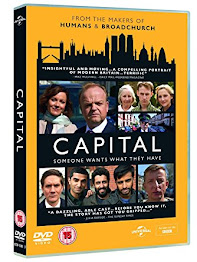
The factsheet suggests that Capital meets crime genre conventions through the mystery surrounding the anonymous postcards stating “We Want What You Have.” This creates narrative enigma and suspense typical of crime dramas. It also follows social realism conventions by focusing on everyday life, contemporary issues and believable characters. The setting in a recognisable London street, naturalistic performances and engagement with real social problems all align with social realist traditions.
The factsheet analyses the DVD packaging as emphasising the ensemble cast and the central mystery. The imagery of the street and the bold tagline referencing the postcards highlight both the community aspect and the suspense element. This communicates to the audience that the drama combines social commentary with intrigue, appealing to viewers who enjoy both character-driven narratives and crime elements.
Applying Stuart Hall’s reception theory, audiences may produce different readings of Capital depending on their social background. A dominant reading might accept the programme’s critique of inequality and capitalism, seeing it as a realistic portrayal of modern Britain. A negotiated reading might agree with some themes but question others, while an oppositional reading could reject the idea that wealth is the central problem. This shows how audience interpretation is shaped by personal experience and ideology.
1) Write an analysis of the representations in each of the key scenes from episode 1 we studied in the lesson:
In the opening sequence from 00:30 to 4:49, London is represented as wealthy but divided. The camera moves across Pepys Road, emphasising high property values and attractive houses, which represent the success of global capitalism. However, the anonymous postcards reading “We Want What You Have” immediately introduce tension and suggest resentment and inequality beneath the surface. The street becomes a microcosm of 2015 London, shaped by gentrification and rising house prices. The representation of London is both aspirational and threatening, showing wealth alongside insecurity.
In the scene showing work in the City from 6:28 to 8:10, masculinity, capitalism and power are central. The City workplace is represented as fast-paced, competitive and dominated by financial ambition. Mark, as a banker, embodies corporate masculinity and is associated with risk-taking and economic instability. This links to post-2008 financial crisis anxieties, presenting the financial sector as both prestigious and morally questionable. London here is shown as a global financial hub, reinforcing its identity as a centre of capitalism.
In the scene “Which of those isn’t absolutely essential?” from 14:00 to 15:35, family and inequality are foregrounded. The conversation about household expenses highlights the pressure of maintaining a middle-class lifestyle. Despite apparent wealth, there is anxiety about money and job security. This challenges the stereotype that affluent families are financially stable and instead shows how capitalism creates constant insecurity. Gender roles are also subtly represented, with domestic financial management becoming a source of tension within the family.
In the asylum scenes from 18:03 to 19:42 and 31:10 to 32:40, immigration and state power are key representations. The asylum seeker is portrayed sympathetically, emphasising vulnerability and fear of deportation. The immigration authorities are shown as bureaucratic and impersonal, reflecting wider 2015 debates around migration and border control. This representation challenges negative stereotypes of asylum seekers by humanising the character and focusing on emotional impact rather than political rhetoric.
In the scene “What use is 30 grand?” from 36:40 to 39:00, wealth and generational differences are highlighted. The older character questions the value of money in relation to happiness and stability. Aging is represented as reflective and sceptical of rapid economic change. This contrasts with younger or wealthier characters who measure success financially. The scene critiques materialism and suggests that rising house prices distort values and priorities within communities.
In the corner shop scene from 40:10 to 42:55, ethnicity, religion and community are central. The shop is represented as a social hub, reinforcing multicultural London. The Muslim family running the shop are shown as hard-working and community-focused, challenging stereotypes that often associate Muslim characters with extremism or isolation. Instead, they are integral to the neighbourhood’s identity. The shop also symbolises small businesses struggling within a capitalist system dominated by property wealth.
2) How does Capital use stereotypes? Do the characters and issues represented in Capital reinforce or subvert the stereotypes we typically see in the media?
Capital both uses and subverts stereotypes. It initially presents recognisable types, such as the wealthy banker, the immigrant shopkeeper and the vulnerable asylum seeker, which helps audiences quickly understand social roles. However, the drama complicates these stereotypes by giving characters emotional depth and moral complexity. The banker is not purely villainous, the immigrant family are shown as stable and integrated, and the asylum seeker is humanised rather than criminalised. By layering these representations, Capital challenges simplistic media portrayals and instead presents a nuanced picture of 2015 London shaped by inequality, diversity and capitalism.
The parent company for Kudos is Banijay UK Productions, which is part of the larger Banijay Group. Kudos has not always been owned by Banijay; it was originally an independent company founded in 1992. In 2007 it became part of the Shine Group, then in 2015 it became part of the joint venture Endemol Shine Group, and in 2020 Endemol Shine was acquired by Banijay, making Banijay the current owner of Kudos. These changes in ownership illustrate how a small independent producer can be absorbed into an international media conglomerate over time.
2) Watch the showreel on the Kudos website. What other TV dramas have Kudos produced and for which channels? What awards have they won?
The Kudos showreel highlights several other TV dramas they have produced for major channels. These include Broadchurch for ITV, Humans for Channel 4 and AMC, Grantchester for ITV, Tin Star for Sky Atlantic and Amazon, Deadwater Fell for Channel 4, This Town for BBC One, and many others such as Apple Tree Yard and The Tunnel. These shows have gained recognition and awards over the years, with Broadchurch in particular receiving critical acclaim and awards from television bodies, and Kudos itself being voted Best Independent Production Company by Broadcast magazine in 2007, showing its success and reputation in the industry.
Capital helps the BBC fulfil its remit as a public service broadcaster by providing original British drama that reflects contemporary society, culture and issues relevant to UK audiences. As a drama set in London that explores social issues such as inequality, immigration, diversity and economic pressures, Capital aligns with the BBC’s obligation to inform, educate and represent the nation. Through diverse characters and themes that reflect real British experiences, the drama supports the BBC’s mission to serve the public interest rather than purely commercial goals.
1) How does the programme information on page 3 make Capital sound interesting to audiences?
The programme information makes Capital sound interesting by presenting it as a dramatic mystery about one London street, with interwoven character stories, social themes about modern life, and a diverse cast whose lives are connected by the mysterious postcards saying “We Want What You Have.”
2) Who commissioned Capital for BBC?
Capital was commissioned for BBC by Charlotte Moore (Controller of BBC One) and Ben Stephenson (Controller of Drama).
3) Read the interview with Toby Jones. What does he say about the character of Roger?
Toby Jones says Roger is not an evil banker but a complacent one, used to a wealthy lifestyle and feeling internal dissatisfaction and loss of direction, even though he cannot fully understand or express it.
4) Read the interview with Adeel Akhtar (page 10). What does he suggest Capital says about the fictional Pepys Road and the sense of community (or lack of it) in London?
Adeel Akhtar suggests Pepys Road represents many streets in London where social and economic change is happening, and the show explores belonging, community and how some people feel excluded or “on the outside looking in.
5) Read the interview with Shabana Azmi (page 12). What does she say about Asian representations in Britain?
Shabana Azmi says the Kamal family reflects modern Asian life in Britain, showing strong characters and highlighting how cultures mix in a “global village,” rather than using stereotypes.
6) Read the interview with Derek Wax, the Executive Producer for Kudos (page 16). Why did he produce Capital and what does it say about the way we live now?
Derek Wax says he produced Capital because the novel captured life in London through one street, and it reflects modern society’s obsession with property, inequality between rich and poor, money, and how people define themselves through their homes and lifestyles today.
Comments
Post a Comment